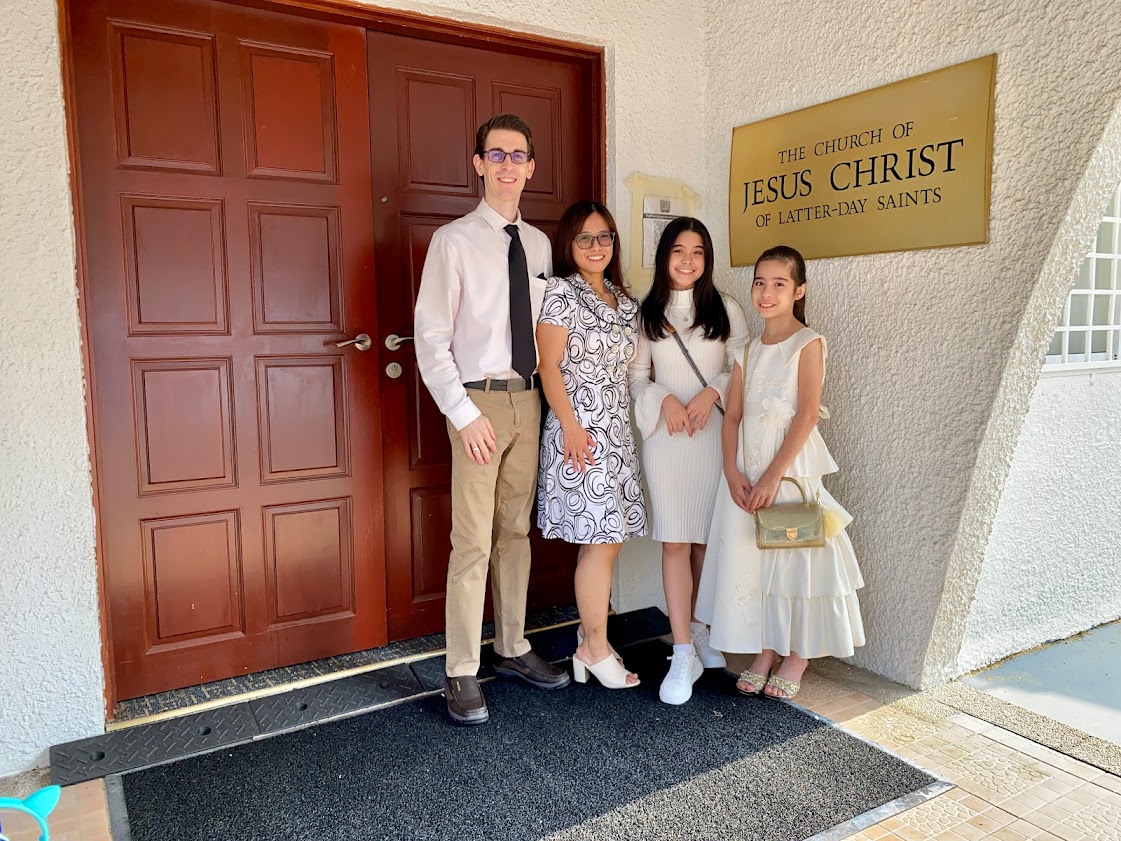
This is one post in an A-Z series of 26 where I am writing about living as a Mormon in the wilderness of Kuantan
I live in the beautiful town of Kuantan, Malaysia. For everything it gives us, it doesn't give us our church. In this respect, we live in isolation. Isolation from a meetinghouse. Isolation from fellowship. Isolation from religious responsibilities.
I have often spent time in deep thought comparing being in isolation to living near the church, being in close contact with other members, and having specific and frequent duties in the church. I'm not entirely sure which I prefer.
In November 2015 we went back to England for a family holiday where I surprisingly enjoyed the 3-hour block of church services (In Kuantan we meet for around 30 minutes. At our home. Just our family). I miss being in Sunday School classes in regular church and sharing my thoughts and opinions with others. On the flip-side, it was depressing to hear public prayers filled with the same robotic phrases that rendered the plea meaningless. It was however, beautifully refreshing to hear an old friend offer extraordinarily meaningful and personalised prayers in clear, easily-understandable language. This was a man who valued prayer not as a robotic exercise of cramming in as many cliches as possible, but who thoughtfully spoke from his heart and mind.
I fondly refer to our isolation as "living in the wilderness."
We have learned some valuable lessons while practising our faith in isolation. Two of the more drastic ones I'll share here.
1. RELIANCE ON GOD AND OURSELVES
In a normal congregation, one can rely on teachers to lead lessons, the bishop/branch president to plan the meeting, youth leaders to take care of the teenagers, primary teachers to nourish the children, and friends to provide fellowship. we can rely on study guides and manuals for convenient reading. Living in the wilderness we get none to very little of these things so instead we develop a strong reliance first on God, and second on ourselves.
For the first 23 years of my life I lived in ward boundaries and went to church with over 100 other people. For the next ten years, we have been living in the wilderness. The trek to the wilderness was a kind of shock horror moment. I had previously gained the impression that my spiritual convictions, standing before God, and ability to keep my covenants was dependent on being in church, having callings, being present in all Sunday lessons and participating in extra-curricular church activities.
The instructor of one of those extra-curricular church activities at the time I was around had made it a habit to continue urging me to attend despite it being against my wishes. I had informed him on a number of occasions that I thought I couldn't make it but the pestering continued. It wasn't until I told him face-to-face of my intention to exercise my freedom to choose not to attend this particular activity and to request a halt to the persuasions, that the message finally hit home. Looking back on this episode now, I can see how my spiritual standing is not at all connected to schemes, no matter how honourable their intentions.
Being away from all of this eased the initial burden, and over the years I have come to see that my spirituality and standing before God is not at all dependent on the church - it is actually dependent on me.
In the process of discovering a new-found reliance on God, our gratitude and requests in prayer have become more specific and heartfelt. In difficult times when there is no-one remotely close to rely on, we rely on God, and then ourselves. On occasion, the order switches. We do everything we can of our own ability, and then rely on God's grace to do the rest. What we have also learned is that there are lots of people who are not Mormons who have extended invaluable assistance to us, without such service, we would not have been able to accomplish many things. God places people in our paths whether they may be Mormons, Christians, Muslims, Atheists or whomever. The same praise then, ultimately goes to God.
2. DESIRE TO LIVE OUR FAITH
We practise our faith because we really want to. Not because we live amongst other members and easily follow the crowd. We are in all reality entirely responsible for our own spirituality and the depth and strength of our spiritual convictions
It is extremely rare to receive visits from anyone in our church (the distance explains that). We don't get nourished weekly by the church but we do try to follow along with the church's yearly study themes. For the most part, we don't have rigid plans for our spiritual nourishment. I study the gospel because I choose to do so. Because I want to. It enlightens my mind, provides stimulating thinking, and gives a sense of fulfillment. Out here in isolation, no-one tells us to stay strong in faith, no-one checks on us, no-one pays us monthly visits as is the norm as part of a regular church congregation.
SCRIPTURAL SIMILARITIES
Our isolation in Kuantan may be likened to a few scriptural similarities.
Moses headed his people away from their Israel home and wandered in the wilderness for forty years. At least they still had each other for support and fellowship. It wasn't easy though, as they frequently struggled through tests of perseverance, but God continued to guide them.
In the Book of Mormon, Lehi and Ishmael and their families became isolated from their Jerusalem home as they travelled through the hostile Arabian Desert wilderness for eight years. It wasn't easy though, as they frequently struggled through tests of perseverance, but God continued to guide them.
Perhaps most comparable to our episode in Kuantan would be the ordeal faced by Moroni, the last remaining Nephite of his civilization. He recorded a very poignant excerpt describing his loneliness as he wandered the land, disconnected from all other people. What little we know of his last mortal days is that he wandered alone, perhaps to great distances to avoid capture by the Lamanites, with the scenes of the death of his people fresh in his mind. We can only assume that it wasn't easy, that he frequently struggled through tests of perseverance, but that God continued to guide him to the right spot to hide the 1,000-year record of his fallen people. And because of his very isolation, we have that record in our hands today.
Not to say that our modern life in 2016 in Kuantan is as epic or life-changing as those examples. We do however similarly feel that it's not always easy, that we do frequently struggle through tests of perseverance, but that God continues to guide us while in isolation, while living in the wilderness of Kuantan.
We need this wilderness experience. We need to learn the lessons it provides. I have embraced this journey.