Showing posts with label mormon. Show all posts

Tuesday, 4 April 2017

Starting Anew

This post is a response to a post last month titled Swamped down by the world where I revealed my struggles with getting away from worldly things as it interfered with my spirituality.

Below is my video message addressing those issues and how I have tried to overcome them for the last month:


Thursday, 28 April 2016

eX-Mormons


This is one post in an A-Z series of 26 where I am writing about living as a Mormon in the wilderness of Kuantan


Ex-Mormons can be generous, kind, loving, family-oriented, opinionated, idiotic, stubborn, vengeful.

Mormons can be generous, kind, loving, family-oriented, opinionated, idiotic, stubborn, vengeful.

Hope that clears it up.


This is a post stemming from my very first posting here on open-minded-mormon titled Building bridges in interesting times. It's worth reading that post as a little background to this one.

Ex-Mormons, if treated in the right way, can open some valid and insightful discussions and questions regarding the church, its history, and policies. And it's not even left to ex-Mormons to do deep digging. Church members, most notably Kate Kelly, founder of the Ordain Women movement, was excommunicated from the church for preaching her viewpoints which the church perceived to be in opposition to its own stances. Sometimes it takes people like Kate Kelly to cause us to think deeper, to cause changes for the better in the church. Ex-Mormons have quite different perspectives on the church from the typical comfortable member.

While it may be impossible to agree with each other's opinions, we can at least be agreeable in our understanding of and empathy for one another.

Ex-Mormons usually make a firm point of how happy they are after leaving the church, which is probably correct. But it doesn't mean that the happiness I feel in the church is in any way less than theirs.


I don't have to renounce my faith to be happy.

I don't have to leave the church in order to see other perspectives.

I don't have to forfeit my spiritual convictions in order to be open-minded.

I don't have to abandon my beliefs in order to acknowledge and consider mistakes of past or current church leaders.

I don't have to fight against the church collectively just because one person offended me.


From my observation, a lot of ex-Mormons are not necessarily bad people, they have just been perhaps treated harshly or unfairly by certain people in the church; they have been offended by one person's lack of empathy or unkind words or bad example; they have been overburdened with callings and responsibilities; they feel cheated by the church when they learn of proposed mistakes or contradictions in early church leaders or on points of doctrine or practise; they have differing personal opinions to church policy which leaves them marginalized and criticized by the majority.

I think we can show empathy, defend the faith, and do so with increased kindness so that we can build bridges instead of erect walls.

Wednesday, 27 April 2016

Women and the priesthood


This is one post in an A-Z series of 26 where I am writing about living as a Mormon in the wilderness of Kuantan


We need to get away from the thinking that holding the priesthood is the be-all and end-all of membership in the Mormon church. That somehow it is advantageous now and in the hereafter to be a priesthood holder.

It is not.

While the priesthood is important in administering the ordinances of the gospel, it cannot serve itself. It can only benefit and bless the recipients of the ordinances it authorises. It has no bearing on ability to receive spiritual convictions concerning the doctrine of Christ. Every man, woman or child in the church may receive personal revelation for themselves or their families. Such spiritual messages are not dependent on bearing the priesthood.

As a man, it is a duty that I didn't choose, but one that was willingly thrust upon me. I honour the priesthood I hold as it enables me to serve the sacrament of the Lord's Supper to my family each Sunday in the wilderness of Kuantan. It blesses me and my three girls in equal measure. We are all able to partake of the same emblems and associated covenants because of it.

The priesthood also serves a man and a woman in a temple by pronouncing the exact same covenants and eternal blessings on both of them at the marriage altar, representing the highest gospel ordinance available to Mormons, received equally by both sexes.

The woman is in no way disadvantaged by the use of the priesthood or the blessings it prescribes.

The "Ordain Women" movement could be looked upon as a landmark turning point in gender equality, or an ill-advised and misunderstood concept of church organisation. The day came when black males were informed they too could receive the priesthood. We may live to see the day where females are informed they can receive the priesthood. As with most policy changes in the church, it has to be at the right time and according to shifting circumstances, which we are certainly seeing now with the Ordain Women movement.

However, there is an order to how the church is arranged as it currently stands, and that order is connected to the allocation of priesthood responsibility to the males, and predominantly family responsibility to the females. The church has been taking steps to involve women more in previously all-male general church councils, which is definitely an exploratory step in the direction of ordination for women.

It's hard to imagine what would happen should these gender-defined responsibilities suddenly cease to be segregated by sex. Perhaps the order in the church would turn to chaos. Women would be seeking men's roles and vice versa. Roles which each may not be best-suited to as compared to the opposite gender. For example, a man may receive a calling in primary being alone in a room full of small children. A woman may not enjoy leading a sometimes rowdy bunch of teenage boys, neither might it be appropriate for a man to take charge of a group of adolescent young women. Suddenly, a baptism in the family would turn into an agonising decision as to whether the husband or the wife performs the baptism. Would revelation for the entire church flow as smoothly and reach unanimous decisions if the general leadership was a mixed bag of both women and men? 

I asked my wife about these issues to get a female perspective on women and the priesthood. And believe me, I pressed her on it! Among other things, I asked her if she felt marginalised in the church as every major decision is made by men. Was she satisfied with the perceived lack of equality between the genders? I was a little surprised to hear her rebuke me and inform me that she has so many other things going on in her life with family duties that she would have no time or effort left to hold the priesthood, attend meetings, fulfill callings that would then become possible as a priesthood holder. She left me in no uncertain terms that she is perfectly happy with how the church is ordered now, that she feels fine with letting the men get on with the church business. She ended by saying she wouldn't even want to receive the priesthood!

Time will tell what direction the church takes, how it responds to the changing circumstances, and whether by divine decree, women are instated to the priesthood here on earth.

Tuesday, 26 April 2016

Vicissitudes of life

This is one post in an A-Z series of 26 where I am writing about living as a Mormon in the wilderness of Kuantan


The vicissitudes of life describes the constant state of change we encounter. Changes in age, health and career happen to all of us. The vicissitudes I will talk of here are church-related.

The Mormon church has changed a lot since its beginnings in 1830. These vicissitudes are worthy of analysis, sincere questioning and an effort to understand.

Some of the vicissitudes of Mormon history include the implementation of polygamy and its later cessation, the priesthood being extended to men of all races and colours, the method of succession to the Presidency, as mentioned in "Quorum of the Twelve Apostles", age for full-time missionaries, and the essays released on the church website, www.lds.org, albeit hidden away, representing the church's publicizing of previously 'dark' information.

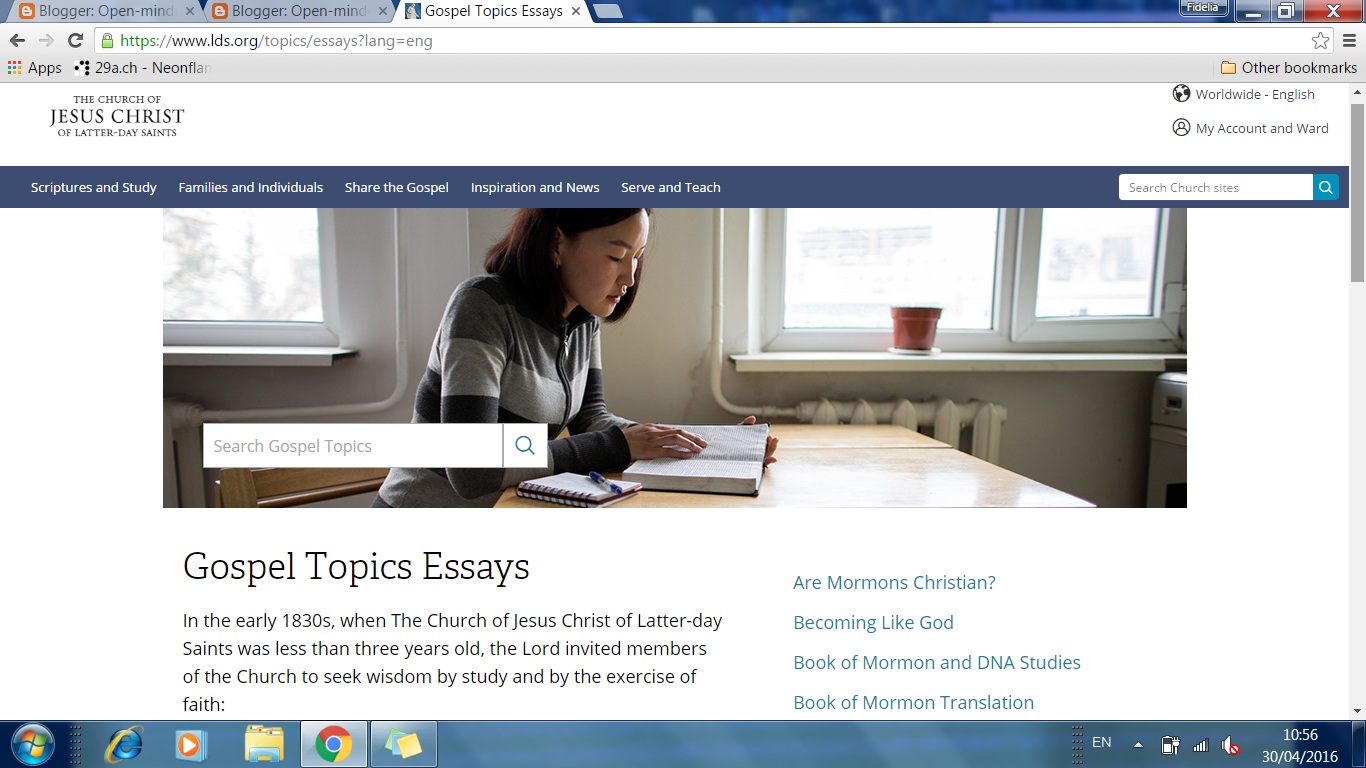
On lds.org, you have to click "Scriptures and Study" ---> "Gospel Topics" ---> "Explore the essays" to locate the newly released essays providing detailed information on issues such as Book of Mormon translation, polygamy and Race & the Priesthood
While such changes may well have received some sort of divine command, it is apparent that they were not wholly decided upon by revelation. Many of these vicissitudes came as a result of fierce opposition by non-Mormons, fellow members and governments, with revelation merely confirming the need to change according to different circumstances.

The fact that the Mormon church is a changing church may demonstrate two opposing sides of a pendulum - to some it shows deceit, bending to the will of the world and its increasing worldliness, and a string of losses to outside influences suggesting a church that is not being led by God, but by imperfect men - on the other side, and to the more rational thinkers, we may note the church's adaptability to changing times and different circumstances, awareness of outside concerns, and willingness to change for the better.

To be honest, an organisation like the 15 million-strong Mormon church would find it nigh impossible to remain stagnant in policy and organisation from the 19th through 21st centuries. Any company would crash if it didn't change and adapt.

As an example, my English company has already adjusted policy a few times in just four years, in response to suit our clients' needs and adapt to our growing size. Without such changes, it would be easy to rapidly become irrelevant and inconvenient.

The Mormon church runs on principles of continuing revelation and inspiration making it reasonable and frankly necessary for changes in policy or stances to occur. Obviously, 19th century stances on race, slavery and equality are entirely different from those of the 21st century, for example.

These church-related vicissitudes often facilitate the increase of light and knowledge on certain issues and provide great learning opportunities.

Sometimes, the changes might be that specific issues are spoken of with more frequency, for example the recent increase in discussions on homosexuality and gay marriage and the church's definition of marriage. The church has a tricky balancing act as it can only change on policy within the parameters of God's standards of living which it declares. For example, the church can acknowledge that people have homosexual tendencies, but it cannot allow such people to be married in its churches or temples as the doctrine of the organisation states that marriage is between a man and a woman. Such couples may freely find an organisation with standards that allow such marriages.

Living in the wilderness, we are away from the hubbub that sensitive topics which have become embraced by the world, generate. Granted, social media brings some of that commotion to us, but it's certainly nice to be away from the crowds of church members where I can formulate more easily my own thoughts and opinions on these important vicissitudes without them being concentrated by popular Mormon cliche.


Saturday, 23 April 2016

Testimony

This is one post in an A-Z series of 26 where I am writing about living as a Mormon in the wilderness of Kuantan


In many a discussion with non-member friends, we have come to a crossroads over "testimony" and Mormons' oft-repeated declaration of "I know" when sharing about spiritual feelings. How can one bear testimony of Joseph Smith and his role as an authorised prophet when we haven't even physically seen him, nor possess any sort of personal physical evidence that such a person actually existed? How can we say "I know God lives" when it's near enough physically impossible to see God? And they are fair points which I took on board and pondered. I came to wonder what exactly is my testimony.

A testimony is described using words such as 'witness', 'evidence' and 'proof', which physically speaking makes our familiar declarations of God, Jesus and Joseph Smith somewhat inaccurate.


What I think we really mean by sharing our testimony is 1. making a statement of what we believe to be true, and 2. declaring what we know to be true after obtaining such information by personal spiritual means, for example through the gift of the Holy Ghost or by the spirit of Christ, and not necessarily by physical means.

And we are all able to receive that type of conviction according to our desires.

Elder Dallin H. Oaks explained it succinctly:

"When we know spiritual truths by spiritual means, we can be just as sure of that knowledge as scholars and scientists are of the different kinds of knowledge they have acquired by different methods." (General Conference, April 2008)

As Mormons, we term this set of beliefs as "testimony" - I prefer to label it as "spiritual convictions."

In the Book of Mormon, a man named Alma used a tree as an analogy in testing the word of God to gain spiritual convictions. At one point he said:

"And now, behold, is your knowledge perfect? Yea, your knowledge is perfect in that thing, and your faith is dormant; and this because you know, for ye know that the word hath swelled your souls, and ye also know that it hath sprouted up, that your understanding doth begin to be enlightened, and your mind doth begin to expand."
(Alma 32:34)

In bearing testimony, or sharing spiritual convictions, of the truths of the restoration, it's not that we saw Joseph Smith receive the visitation of God and Christ, not that we saw the golden plates upon which lay the ancient writings that he translated with a seer stone, nor that we saw the angel Moroni visit Joseph Smith on numerous occasions, delivering and later collecting those plates, but that through studying and considering these things in the scriptures and accounts provided, we have noticed the change for better in ourselves. We have become a better person and developed Christlike attributes. We know for certain that the word has swelled our souls. 

Therefore, a Mormon testimony, as it is called, becomes more of a witness of ourselves - of the positive change which has taken place in ourselves because of the words of God. It's like saying,

"Look what the restoration has done for me. Look what the doctrine delivered from Christ to Joseph Smith and Joseph Smith to me has done for me. It has made me better, enlightened my mind, expanded my thoughts and increased my spiritual convictions. Therefore 'I know' that the Book of Mormon, the source of this increased spirituality, is true and that Joseph Smith served as a prophet of God."


We bear testimony or share spiritual convictions of the truth of the restoration and the divinity and works of Jesus, and we do so because of the visible, tangible impact they have had on us.

Friday, 22 April 2016

Self-reliance

This is one post in an A-Z series of 26 where I am writing about living as a Mormon in the wilderness of Kuantan


The ultimate aim is not for us to be dependent on an organisation but to be able to be self-sufficient beings. The Mormon church tries to strike a balance between being merciful to those who stand in need of mercy (see the Christlike stance on refugees), and helping all become self-reliant (note the extra-curricular self-reliance classes held by church members around the world).

I am a stubborn supporter of self-reliance and demand it of everyone, but when urged by my better half, show mercy to those in need. After all, I was in need of monetary help before, and had a good friend who willingly obliged.

My pride was dented in having to ask for money, even though my friend understood our immediate need and had earlier said he was ready to help when needed.

Raymond, front centre, helped me out financially when I stood in need
 We duly paid him back in installments and determined to never have to borrow of others again. It was a horrible feeling to ask for help. I felt that I couldn't provide for myself or my family. I felt very small. It was a very humbling experience.

We gained great motivation to work harder and save more. To consciously save money and build our savings. To be a little more frugal in our spending. To be in a position to not have to rely on anyone else for our welfare.

And I can tell you, that is an awesome feeling!

Living in the wilderness of Kunatan, we don't have an immediate branch leadership that we can turn to when in need. We belong to the KL branch which is 3-4 hours away and we know just a handful of people there. So we understand that we are isolated from the church and this spurs us on to never need to rely on the church - for money, or for spiritual light.

We have to be responsible for our spiritual welfare too. That probably comes at a greater degree of difficulty than earning money. With no lessons to prepare for Sunday School, no fellowship with other members, no mid-week activities, living as a Mormon in the wilderness can be incredibly tough spiritually. It is unimaginably easy to 'forget' to pray and for scripture study to become obsolete. 

On the flip side, guided by the Spirit we have become our own teachers, escaped all the horrible cliches associated with groups of Mormons stuck in repetitive circles, and learned to rely more strongly on God's grace for our spiritual nourishment.

We see things in an entirely new light, looking at gospel topics from different perspectives, living the gospel with more pronunciation and decision, according to our circumstances. Such spiritual self-reliance we could not have developed as personally in more tight proximity to the church.

I finish with this scripture, which has been applicable to us:


 26 For behold, it is not meet that I should command in all things; for he that is compelled in all things, the same is a slothful and not a wise servant; wherefore he receiveth no reward.
 27 Verily I say, men should be anxiously engaged in a good cause, and do many things of their own free will, and bring to pass much righteousness;
 28 For the power is in them, wherein they are agents unto themselves. And inasmuch as men do good they shall in nowise lose their reward.
 29 But he that doeth not anything until he is commanded, and receiveth a commandment with doubtful heart, and keepeth it with slothfulness, the same is damned.
- Doctrine & Covenants 58: 26-29

Tuesday, 19 April 2016

Power of God - A study

This is one post in an A-Z series of 26 where I am writing about living as a Mormon in the wilderness of Kuantan


Have you ever read the Pearl of Great Price and felt totally inspired afterwards? I experienced such feelings as I made my way through this translation of the writings of Abraham and Moses, in particular Abraham chapter 3.

This chapter is a great lesson on astronomy provided by the Master Astronomer Himself, to the Prophet Abraham.

Here I learned of the great governing star in the heavens, named Kolob, because it is the closest to God's residence. It is set to govern all other planets like and including our very own planet Earth. Each planet and star has its own times of reckonings and revolutions, Kolob taking 1,000 earth years to rotate on its axis. Hence comes the saying in Mormonism that one day is a thousand years to God.

The Lord then teaches Abraham that where two things exist and one is greater than the other, there shall be something above them even greater. At this point I was beginning to sense the never-ending nature of God's creations.


Abraham was taught and tutored by the greatest of all scientists, astronomers, physicists - the Lord God, Creator of heaven and earth and all things. In today's world, there are many noble scientists and astronomers who are beginning to see further and further into space, exploring galaxies that were never even known to have existed a few decades ago.

Yet the human eye and telescope has limited powers. We can only see so far. Yet Abraham, according to the record, was shown all things by the Lord, even until Kolob. The works of God's hands were multiplying before his eyes that he could not see the end thereof.


This is true power, infinitely stronger than that which any human can muster. The light which fills the immensity of space, which penetrates all things from the bosom of God, is what true power is all about. It is the power of righteousness and glory, intelligence and immortality.

How can humans undermine the power of God? We hear of the popular lament that God was not around to save a loved one from dying. If He was so powerful he would show Himself unto us. 

Yet when I reflected on the writings of Abraham, I had no doubt that somewhere out there, uncountable light years away in the immensity of space, our grand Father is sitting upon his throne, watching over us, seeing all things past, present and future as if they are continually present before Him, showing forth His power day and night through the sun, the moon and the stars. They are signs of His light and power, that He is there, and that He cares deeply about our progress back to Him.


I found myself staring out of the window into the blue skies shortly after finishing this chapter with a silent offering of gratitude for this great knowledge that I had gained. I felt very close to God at this moment than I had for a long time.

Just me and God.

My mind in that moment of quiet sacred struggle and earnest willing contemplation was urging itself to believe. I allowed it.

Soon after, I read the words of the Mormon hymn, If You Could Hie to Kolob which gave me yet deeper insights and left strong impressions upon my mind. I began to see the eternal picture and the grand scheme of things.

One of the mysteries of godliness had been unfolded to my mind.


What is your idea of eternity? How do you recognise the power of God in your life? Do you allow yourself to believe in the things of God?

Monday, 18 April 2016

Open-minded Mormon

This is one post in an A-Z series of 26 where I am writing about living as a Mormon in the wilderness of Kuantan


Why did I choose to name my blog 'Open-minded Mormon?'

There is a perception that Mormons are stuck in their own bubble, blindly follow church orders, and are ignorant of all else. And there are those who fit that description.

However, I don't like generalising things and I don't like being generalised.

In addition to submitting to the requirements of belonging to this organisation, I have a brain and a conscience and can think things through for myself.

Open-minded Mormon represents my personal thoughts about church doctrine, policy and stances. It's a place for me to state gospel teachings and/or history and share my own perspectives on it.

I think it's an unfortunate perception people have of Mormons that we are a people who don't entertain anything outside of Mormonism as valid (the Mormon doctrine of exact obedience is often mistakenly taken as a war cry in rejection of all else). That we accept the church's stance on issues without thinking for ourselves. Or that we never feel any sense of disagreement with leaders on certain issues.

For a religion that accepts wild and wonderful events as part of its established history as well as previous periods of polygamy and racism (which are thankfully over), we should be amongst the most open-minded people in the world.

As I've matured, I have determined that there is a far greater value and a much richer experience in opening my mind outside the circle of Mormonism, getting away from Mormon cliches, and reaching a point where pure faith once was - 

me and God.

And that is not something that should seem alien to us. We are repeatedly urged not to trust in the arm of flesh (ie. church leaders or others great or small) but to personally consider and pray about things in order to receive a spiritual confirmation of the truth and of the way in which we should lead our personal and family lives.


As a result, I spend more time thinking. Wondering. Contemplating. I carefully question things I had automatically accepted before. I take responsibility for my own spiritual development.

It is just me and God.

I love being in that place where it's just me and God. Where there is no distraction of other people. Where there is no doctrine but what thoughts and impressions occupy the human mind when contemplating Space, Divinity, Eternity, and God.

Just me and God.

That's where deeper perspectives are formed. It has happened for me in prayer. When staring out the window into the skies. When sitting in a quiet part of the house getting lost in silent thoughts. In scribbling down ideas that seem to be whispered into my conscious mind.

Me and God.


Friday, 15 April 2016

Mormon

This is one post in an A-Z series of 26 where I am writing about living as a Mormon in the wilderness of Kuantan

The word 'Mormon' is inextricably linked with The Church of Jesus Christ of Latter-day Saints. It always has been and always will be.

Of course, the beginnings of Mormonism and why it is referred to as such, are rooted in the appearance of the Book of Mormon, touted by Joseph Smith as an additional book of scripture. He found the record buried in the ground and translated it first using instruments provided with the record, and second with a gemstone he previously discovered in a mine.

Joseph Smith's seer stone which he found in a mine and later used in the translation process of the Book of Mormon


An artist's depiction of Joseph Smith translating the Book of Mormon record by using a seer stone in a hat which revealed characters followed by their translation in English


It's an incredible set of circumstances and claims, which incidentally, I have spent 14 years seriously studying and believe to be entirely factual. 

But you can imagine the wild excitement at the time the Book of Mormon seemed to pop out of nowhere. People believing in the Book quickly began to be called 'Mormons' in a derogatory fashion. So for those on the outside, we became known as Mormons and the Mormon Church and our theology became known as Mormonism.

In more recent times, the church appears to have taken on the stance, "if you can't beat them, join them," and now embraces to an extent the name 'Mormon' when describing the church and its members. It now also helps in quickly identifying who we are, which is more difficult when using the real name, 'The Church of Jesus Christ of Latter-day Saints.'

Regardless of the process by which the Book of Mormon was translated, and how valid or scandalous one may view it, the proof is in the pudding, so to say.


Now, I have traipsed through the quagmire of etymology surrounding the word 'Mormon' including the oft-quoted, perhaps satirical and metaphorical explanation given by Joseph Smith/W.W.Phelps that "Mormon means more good." Mr. Smith was probably trying to portray to his detractors that if the Bible means good, then the Book of Mormon means more good, referring to the more correct translation of the latter.

Mormons who believe that the word literally translates to 'more good' are almost conclusively in error. To break up Mormon as mor- (from English 'more') and -mon (from Egyptian 'good') is impossible as the Nephite people in the Book of Mormon never knew English as the language didn't even exist then. So there is no way that mor- could be derived from the English 'more.' Gordon B. Hinckley, 14th President of the church, commented that Mormon means more good is simply a nice motto for church members to use as they wish.

Studies of Egyptian, Hebrew and Arabic have drawn some possibilities of the root MRM or MRMN as translating to 'good,' 'beautiful,' or 'everlasting love' (Though do take into account that the Prophet-Historian Mormon did compile the Book of Mormon record in Reformed Egyptian).

Which leaves us stuck with an etymological puzzle of Mormon.

Mormon, one of the last of the Nephite people in the record, was named after his father Mormon, who in turn most likely got his name from the land of Mormon, which signifies the first usage of the word, around 146BC. 

In Mosiah 18 we read of this land called Mormon. It was a well-loved place, a place of trees and fountains, obviously very scenic. It was also a place where gospel covenants were administered and received, where spiritual convictions were realised, and where the beginnings of a church of Christ were formed.

The word Mormon is repeated almost a dozen times in Mosiah 18 and six times in verse 30 alone.

Malaysia is my Mormon.

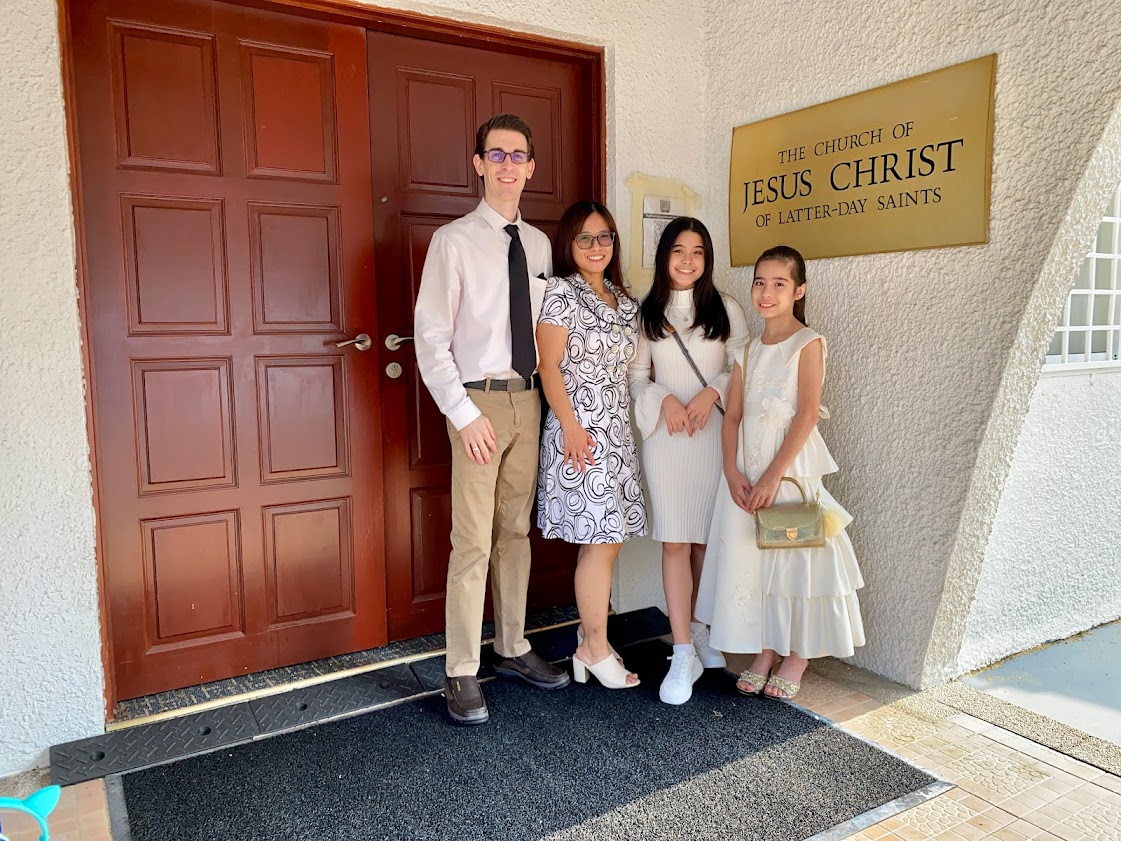
My missionary service was filled with administering and receiving gospel covenants on a regular basis in Malaysia. I lived the gospel with great devotion in Malaysia. Malaysia was a place where I received intense spiritual convictions. I also helped to lay the foundations for a branch of the church to later spring up in Sitiawan, Malaysia.

Malaysia is my Mormon.

Here I am (centre) preparing to administer the gospel covenant of baptism to a consenting candidate, accompanied by other missionaries in Ipoh, Malaysia, 2004


Where is your 'Mormon'? Why is it special to you?
Thursday, 14 April 2016

Liberation

This is one post in an A-Z series of 26 where I am writing about living as a Mormon in the wilderness of Kuantan


I find it liberating to follow a religious organisation that doesn't force me to be or do anything. 

I can choose to live my life exactly the way I want. 

No person in this organisation can force me to stay, neither can they prevent me from going elsewhere. 

I am presented with purported truth and asked to discover its substance for myself. 

I have access to a treasure trove of revealed truth and may interpret and act upon it in any way I wish.

This organisation is striving to be transparent and make historical facts more readily accessible.

I am also able to recognise that this organisation is not the ONLY place on earth where gems of truth can be found.

I am encouraged to seek out and embrace truth WHEREVER it is found.

I am not stuck in my own dogma, but am aware of and have admiration for the faith of all.

I can question anything within this organisation which I don't completely understand until I come to knowledge.

I can use my natural instincts and feelings to decide whether or not to accept responsibilities or participate in programs in this organisation.

I can choose not to follow along with certain widely accepted cultures and traditions  not specific to the whole organisation, and still call myself a follower.

I am ultimately responsible and accountable to one - God.

I love being a Latter-day Saint.

Saturday, 13 February 2016

Stepping outside the Circle

We all live in circles.

Circles of friends. Circles of acquaintances. Family circles. Work circles. Religion circles. Circles of sports. Political circles.


Inside these circles we focus on the associated content of each. We share certain information only with people in specific circles. We find common ground, strong relationships and relatable experiences.

When circles collide, however, things can get a little awkward. Work and family circles often produce conflict, as can friends and religion circles. The degree of importance of circles determines how much time we spend in engaged in each.


And then we have the Mormon circle.

This is a circle of high interest to me as a Mormon. Most Mormons will stay in this circle and never stray outside it's boundaries.

Exact obedience.

Follow the prophet.

Read the scriptures.

Pray.

Family Home Evening.

Things that have become cliches, textbook answers and traditional, typical hallmarks of the Mormon circle. Good things to do? Sure. For a Mormon. These are some of the basic principles of our system of belief and worship, which become integral cogs of our life. But there is so much more to each of these points than meets the eye.

My observation here is that we sometimes need to step out of the Mormon circle.

Outside of the Mormon circle exist millions of other circles containing billions of other people. A plethora of ideas, opinions and viewpoints both favourable and unfavourable towards the Mormon church are out there. 

Considering that amongst our religious claims lies a 14-year-old seeing God and Jesus, an angel showing him an ancient record hidden in the ground, the use of a seer stone to translate that record, and the ancient disciples Peter, James and John visiting the earth to restore priesthood authority, we should be an open-minded people.

We need to have an open mind so that we can step outside the Mormon circle and explore the many different points of view on our faith, take on board other opinions, and learn how to take personal responsibility for our spiritual inclination and growth.

I love the following words of Brigham Young, who was the 2nd president of the Mormon church:

"I am . . . afraid that this people have so much confidence in their leaders that they will not inquire for themselves of God whether they are led by him. I am fearful they settle down in a state of blind self-security . . . Let every man and woman know, by the whispering of the Spirit of God to themselves, whether their leaders are walking in the path the Lord dictates."

We need to get out of the cliched Mormon circle and take a lot more responsibility for our spiritual conviction and condition, becoming spiritually self-reliant. 

And it's only possible when we step outside the circle.

Wednesday, 16 December 2015

Donald Trump Politics and Mormon Belief

Any Mormons watching the Donald Trump campaign trail should see somewhat "eye to eye" {Isaiah 52:8} with his politics and stances. The December 15th debate hosted by CNN (very poorly again, I must say. It appears they are intent on "stirr[ing] them up to anger" {Alma 48:1-4} as was seen in the hilarious duels between Trump vs Bush and Trump vs Paul, for example) highlighted once more the politics of Mr. Trump.

Donald Trump comes across as a strong dictator figure who knows what he wants, will stop at nothing to get it, and will let no-one stand in his way. At the same time, he speaks the truth and has no time for trifling with words {see D&C 32:5}.

But wait a minute, can't Mormons relate to this sort of dictatorship style of leadership? Doesn't Mormon theology state very similar things about Jesus Christ?

The Second Coming of Jesus Christ is an event that Mormons look forward to and enjoy speculating on, yet have no specific date as to when it will happen. And what is it really all about? It's a political event ushering in communism. It's about Jesus coming to demolish all earthly governments and set up his own government with himself as the dictator, with no elections and no change in leader!

As early as the Old Testament we read that "the government shall be upon his shoulder," {Isaiah 9:6} emphasising his potential leadership on earth. While of course, this would refer to his kingdom, or church, it worried the leaders of government enough in his mortal days that Herod ordered all infants below 2 years old to be slaughtered, in an effort to protect his own leadership.

Obviously, if Donald Trump were to be sworn into office next November, he would have a maximum 8 years to serve before he would be obligated to step down.

Mr. Trump's two main stances are to build a wall to separate USA from Mexico, and to block the immigration of Muslims for a period. The building of the wall, as Mr. Trump explains, is to keep illegals from entering the country, amongst whom are drug abusers, dealers, rapists and murderers. The prevention of Muslims entering the U.S. would be enforced under Mr. Trump to stop possible ISIS infiltration into the country. Both sound like decent ideas; both would be very difficult to implement. This is not too dissimilar from Mormon belief where the Book of Mormon states that we should "come ye out from the wicked, and be ye separate, and touch not their unclean things..." {Alma 5:57} Exactly who the 'wicked' are, in both the Book of Mormon explanation and Mr. Trump's plans, can be difficult to decipher. Yet both have this idea of 'separation' from perceived wickedness.

Mormon theology condones and promotes a dictatorship that is ideally led by "just men to be your kings" {Mosiah 23:8}. It is also very clear on the future government of the earth which will be led by Jesus:

"...every ear shall hear it, and every knee shall bow, and every tongue shall confess, while they hear the sound of the trump, saying: Fear God, and give glory to him who sitteth upon the throne, forever and ever; for the hour of his judgement is come." {D&C 88:104}

So Jesus will be the government leader forever without being elected to the position, will be feared, or revered, by all, and will enact laws without approval from anyone else. 

In conclusion, Jesus will separate the wicked from his people AKA he will only allow a certain group of people to be under his government while other groups will be excluded. Sound similar to Mr. Trump's planned policies? Building a big wall, temporarily blocking Muslim immigration?

And before anyone cries 'blasphemy,' I am in no way comparing Donald Trump to Jesus Christ; just demonstrating the similarities in governmental leadership styles and policies, which should be of great interest to Mormons.


Tuesday, 15 December 2015

Building Bridges in Interesting Times

We are living in very interesting and troubled times. The growth and 'coming out' of the gay community has produced a lot of noise and posed many questions for individuals and organisations, including the Church of Jesus Christ of Latter-day Saints. Here we have a religious organisation with revered divine laws which finds itself increasingly struggling against new State laws regarding homosexuality and the now legal union of man and man, woman and woman.

These are interesting times.

Not that the Church has not handled troubles before. Succession in the Presidency, plural marriages and the exact identity of who is eligible to receive the priesthood are just a few examples of how the Church has struggled within itself and with the State regarding important matters.

New resolutions, stances, and laws have always caused a stir and are impossible to please everyone. I believe a healthy discussion of such things is important, and I was fortunate enough recently to be involved in such a discussion on a facebook post. 

This post was written by a friend with a number of ex-Mormons participating in the thread. It went on for a few days as I attempted to have enough empathy to at least leave a good impression with those who have been undutifully treated by the Church, yet also demonstrate a defence of the faith to give credit where it is due.

I was pleasantly surprised to receive a couple of private messages from those who took part in the discussion expressing their appreciation for my efforts and wishing me all the best, despite possessing unceremoniously opposing views on the Church to me. I replied and reached out to two others as well:


It's refreshing and encouraging to see what can be accomplished in terms of building bridges with those of other faiths, and indeed, those who once belonged to our faith. Some differences of opinion may well be irreconcilable but at least we can discuss and be respectful and understanding in these interesting times.